Blog

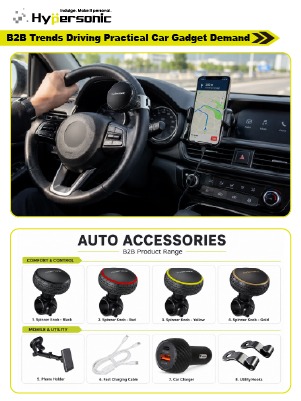
The automotive aftermarket accessories sector is no longer driven only by style upgrades or decorative add-ons. Today, practicality is becoming a stronger purchase driver. Drivers still care about personalization; however, they also want products that improve comfort, safety, convenience, and daily vehicle usability. As a result, the car gadget market is shifting toward accessories that solve real problems rather than simply changing how a vehicle looks.
This shift is especially important for B2B buyers. Distributors, retailers, fleet suppliers, and OEM accessory partners need products with clear value, stable demand, and strong end-user appeal. Therefore, practical accessories such as steering aids, phone mounts, storage organizers, charging devices, safety tools, and comfort-focused interior upgrades are gaining more attention.
The market context also supports this auto accessories trend. The global automotive aftermarket market is estimated to reach USD 464.83 billion in 2025 and grow to USD 555.82 billion by 2030, supported by aging vehicles, digital sales channels, and changing service models. In addition, U.S. consumers spent about USD 52.65 billion accessorizing and modifying vehicles in 2024, showing that aftermarket demand remains strong.
For B2B companies, this means practical accessories are not just product add-ons. Instead, they are becoming a strategic growth category in the modern aftermarket.
Automotive aftermarket accessories are add-on products installed after a vehicle has already been sold. They are different from replacement parts because they usually do not restore a broken system. Instead, they improve the driving experience through better comfort, safety, convenience, storage, appearance, or performance.
For example, some drivers buy seat covers or steering wheel knobs to make daily driving more comfortable. Others choose dash cams, blind spot mirrors, or emergency tools to reduce safety risks. Meanwhile, many modern consumers also look for phone mounts, chargers, and storage trays because these products make everyday driving more efficient.
From a B2B perspective, these products matter because they serve clear buyer needs. Distributors, retailers, and fleet suppliers can position them around practical benefits rather than only appearance. Therefore, automotive aftermarket accessories often create strong sales opportunities when they solve a common driving problem.
Featured snippet answer:
Automotive aftermarket accessories are add-on products installed after a vehicle is sold. They help drivers improve comfort, safety, convenience, protection, or personalization without replacing the vehicle’s original core systems.
|
Category |
Examples |
Main Buyer Motivation |
|
Interior accessories |
Seat covers, organizers, steering wheel knobs |
Comfort and usability |
|
Safety accessories |
Blind spot mirrors, dash cams, emergency tools |
Risk reduction |
|
Convenience gadgets |
Phone mounts, chargers, storage trays |
Daily driving efficiency |
|
Exterior accessories |
Mudguards, trims, roof racks |
Protection and utility |
|
Fleet accessories |
Steering aids, storage systems, safety add-ons |
Driver productivity |
This section defines the core meaning of automotive aftermarket accessories. They are not only decorative products. Instead, they include practical solutions that improve comfort, safety, convenience, storage, protection, and vehicle usability. For B2B buyers, this makes the category valuable because many accessories can be marketed around clear daily-use benefits.
Practical automotive products are gaining demand because buyers now expect accessories to deliver clear everyday value. In the past, many vehicle accessories were treated as “nice-to-have” upgrades. However, the market is changing. Drivers are keeping their vehicles longer, and many prefer affordable improvements instead of replacing their cars. Therefore, practical products that improve comfort, safety, control, and convenience are becoming more attractive.
In addition, urban driving has created stronger demand for convenience-focused products. For example, phone mounts, compact organizers, charging accessories, and storage solutions help drivers manage crowded streets, limited cabin space, and frequent short trips. Meanwhile, comfort-focused products such as seat cushions, steering aids, and ergonomic interior accessories support longer driving hours.
Fleet and commercial users also play an important role in this shift. Compared with casual consumers, fleet buyers often care more about productivity, driver comfort, durability, and repeatable performance. As a result, they are more likely to choose accessories that reduce driver fatigue, improve usability, or support daily operations.
Moreover, online research has made buyers more selective. Customers can now compare reviews, materials, installation methods, and product benefits before purchasing. Because of this, purely decorative accessories may face stronger price competition. In contrast, practical products are easier for B2B sellers to market because they solve clear problems.
From a B2B Market Trend Analyst perspective, companies should study buyer behavior, market structure, customer pain points, and long-term demand patterns before recommending a product strategy. A strong analyst does not only look at short-term sales. Instead, they connect market signals with business opportunities and help companies make data-driven decisions.
This auto accessories trend shows that practical value is becoming a key factor in the automotive aftermarket accessories market.
This section explains why demand is growing for practical accessories. Drivers want affordable upgrades that make vehicles more comfortable, safer, and easier to use. Meanwhile, B2B buyers prefer products with clear benefits because they are easier to explain, promote, and sell. As a result, practical accessories are becoming more important than appearance-only upgrades in the aftermarket.
The auto accessories trend is being shaped by practical business and consumer needs. According to Intel Market Research, the global auto accessories market was valued at USD 80.4 billion in 2025 and is projected to reach USD 116.8 billion by 2034, with a forecast CAGR of 5.6%. This growth reflects rising vehicle ownership, longer vehicle lifecycles, customization demand, and stronger online retail channels.
Many drivers are keeping their vehicles longer because replacing a car can be expensive. Therefore, accessories become a cost-effective way to improve the ownership experience without purchasing a new vehicle. For example, seat cushions, organizers, steering wheel knobs, and visibility tools can make an older car feel more comfortable and usable. As a result, automotive aftermarket accessories are becoming practical upgrade options for budget-conscious drivers.
Online channels also support market growth. Buyers can now compare features, materials, reviews, prices, and installation methods before making a purchase. Moreover, e-commerce platforms make it easier for small brands, distributors, and retailers to reach niche customer segments. This supports both B2C demand and B2B sourcing because buyers can identify fast-moving products more easily.
Drivers now expect accessories to solve real problems. For example, they may want better phone placement, smoother steering control, better cabin storage, or safer visibility. In contrast, purely decorative products can be harder to justify when buyers are comparing practical value.
Fleet buyers care about durability, driver comfort, and operational efficiency. Therefore, practical B2B car accessories can become repeat-purchase items for commercial users. If an accessory improves driver comfort, reduces daily friction, or supports safer operation, fleet buyers are more likely to view it as a business tool rather than a simple add-on.
This section explains the business reasons behind the auto accessories trend. Aging vehicles, digital sales channels, safety expectations, and fleet demand are pushing buyers toward practical accessories. As a result, suppliers that understand these drivers can choose better products, create stronger product positioning, and serve both consumer and B2B markets more effectively.
The car gadget market is expanding because drivers want accessories that make daily driving easier, safer, and more comfortable. Although personalization still matters, practical products are gaining stronger attention because they solve common problems. As a result, several product categories are becoming more important in the broader automotive aftermarket accessories sector.
Comfort and control products are growing because many drivers spend long hours behind the wheel. For example, steering wheel knobs, armrests, seat cushions, pedal aids, and ergonomic driving tools can improve handling and reduce daily driving strain. Okjaws, for example, focuses on steering wheel knobs designed for driver control, comfort, and long-lasting performance. Its products use zinc alloy bases, precision bearings, and screw-secured structures to support durability and stable operation.
In-cabin organization products are also gaining demand. Drivers often need better ways to manage phones, keys, drinks, documents, and small personal items. Therefore, seat gap organizers, trunk organizers, dashboard storage trays, and cup holder expanders are useful for both private drivers and commercial users. Moreover, these products are easy for retailers to explain because the benefit is clear and immediate.
Mobile and charging products continue to grow as vehicles become part of the connected lifestyle. Phone mounts, USB-C chargers, wireless charging pads, and cable management tools help drivers stay powered and organized. In addition, these products fit well with e-commerce because buyers often compare features, compatibility, and reviews before purchase.
Safety-focused products are another strong category in the current auto accessories trend. Dash cams, blind spot mirrors, emergency lights, and tire pressure monitors help drivers reduce risks and improve awareness. Compared with purely decorative products, these gadgets offer clearer functional value, which makes them attractive for both consumers and B2B buyers.
This section identifies the product categories benefiting most from practical demand in the car gadget market. Comfort, control, organization, charging, and safety products are especially important because they solve everyday driving problems. Therefore, distributors and retailers can explain their value more easily, position them around real use cases, and build stronger product selections within the automotive aftermarket accessories market.
B2B buyers are prioritizing practical B2B car accessories because these products are easier to connect with real customer needs. Distributors, wholesalers, fleet managers, e-commerce sellers, OEM accessory program managers, and specialty retailers all need products that can move through the sales channel efficiently. Therefore, practical accessories often create stronger opportunities than style-only products.
For example, a phone mount, steering wheel knob, seat organizer, or dash cam solves a clear problem. Because of this, sales teams can explain the value quickly. In addition, practical products often have stronger repeat sales potential because they are useful across different vehicle types, driver groups, and market segments.
Practical accessories also support better online merchandising. E-commerce sellers can build comparison pages around product features, materials, compatibility, installation, and use cases. Moreover, these products often match stronger search intent because customers look for solutions to specific driving problems. As a result, practical automotive aftermarket accessories can be easier to promote through SEO, marketplace listings, and product education content.
From a B2B Market Trend Analyst perspective, companies should evaluate more than product appearance. They should consider purchasing cycles, decision-making units, buyer pain points, trust, and long-term supplier relationships before choosing which accessories to add to a catalog.
|
Decorative Accessories |
Practical Accessories |
|
Style-driven |
Problem-solving |
|
Trend-sensitive |
More stable demand |
|
Harder to justify in B2B procurement |
Easier to explain with use cases |
|
Often impulse-based |
Often need-based |
|
More seasonal |
More repeatable |
This section explains why practical accessories are attractive to B2B buyers. They are easier to sell, position, compare, and justify because they connect directly to real user needs. Therefore, they can support stronger catalog planning, better online merchandising, and more reliable long-term sales strategies.
The growing demand for practical car accessories creates different opportunities across the B2B value chain. However, each business type should respond in a different way. Manufacturers need to focus on product reliability, distributors need to improve category planning, and e-commerce retailers need to present product value clearly online.
Manufacturers can gain an advantage by developing durable, functional, and compliance-aware products. Since B2B buyers often compare suppliers carefully, clear product specifications, material details, testing information, and installation guidance can build trust. In addition, manufacturers can offer OEM, ODM, and private-label customization to support distributors, retailers, and brand owners with different market needs.
They should also create B2B sales materials, such as product sheets, comparison charts, use-case photos, and packaging information. As a result, distributors can promote the products more easily to their own customers.
Distributors can build stronger product lines around comfort, safety, control, storage, and daily usability. Instead of selling single items only, they can bundle related accessories together. For example, a distributor may combine steering aids, seat cushions, and storage products for fleet buyers.
Moreover, distributors can educate retailers with trend reports, product training, and sales sheets. This helps retailers explain product benefits more clearly and improves channel confidence.
E-commerce retailers can benefit by optimizing product pages for long-tail search terms, comparison keywords, and buyer pain points. Product content, metadata, filters, and clear descriptions help improve discoverability and conversion in digital commerce environments.
For example, retailers can use comparison charts, installation videos, FAQ sections, and lifestyle images to show why a product matters. In addition, pages can link naturally to steering wheel knobs for distributors, how to choose durable car accessories, and a Taiwan automotive accessory manufacturer page to support SEO and buyer navigation.
This section shows that the market trend creates different opportunities for every B2B role. Manufacturers can focus on product quality, customization, and sales support. Distributors can improve category planning and product bundling. Meanwhile, e-commerce sellers can use better content, SEO, product education, and digital merchandising to increase buyer confidence and improve conversions.
However, growth does not mean every product will succeed in the automotive aftermarket accessories market. As demand increases, competition also becomes more intense. B2B buyers are becoming more cautious because they need products that are durable, well-documented, easy to install, and suitable for their local market requirements.
One major challenge is product quality inconsistency. Some low-cost accessories may look attractive at first, but poor materials, weak structures, or unstable performance can lead to returns and customer complaints. In addition, price competition is common in crowded online marketplaces, where many similar products compete for attention. As a result, suppliers must prove value beyond low pricing.
Counterfeit and low-grade products also create risk for distributors and retailers. Poorly made B2B car accessories can damage brand trust, especially when buyers cannot clearly verify material quality, production standards, or product origin. Moreover, weak packaging, unclear branding, and poor installation instructions can make even useful products harder to sell.
Compliance and safety concerns are another important issue. Transportation and automotive experts need to consider vehicle safety standards, vehicle modification rules, product liability, and accessory integration risks when evaluating automotive accessories. Therefore, suppliers should provide clear specifications, installation guidance, and market-specific compliance support when possible.
This section makes the article more balanced and credible by showing that market growth also brings risks. Although demand for practical accessories is rising, B2B companies still face quality, compliance, pricing, counterfeit, and differentiation challenges. Therefore, suppliers need to prove product reliability, safety, usability, and brand value instead of relying only on low prices.
B2B companies should not simply follow every new trend in the automotive aftermarket accessories market. Instead, they should build a clear strategy based on market data, buyer needs, product proof, and long-term sales potential. Therefore, companies that understand both end users and channel buyers will be better prepared to compete.
Before adding new categories, companies should study historical sales data, customer feedback, competitor products, keyword demand, and regional buying patterns. A B2B Market Trend Analyst should also use competitor benchmarking, customer pain point analysis, and demand forecasting before recommending new product categories. As a result, businesses can avoid weak products and focus on accessories with stronger market potential.
Practical accessories become easier to sell when they are connected to specific use cases. For example, companies can position products “for fleet drivers,” “for long-distance driving,” “for senior drivers,” “for urban parking,” “for commercial vehicles,” or “for daily commuters.” This approach helps buyers understand the product’s value quickly. Moreover, it gives distributors and retailers clearer selling angles.
B2B buyers need evidence before they commit to new products. Therefore, suppliers should provide material information, installation instructions, product testing details, warranty terms, use-case photos, comparison tables, and distributor-ready product sheets. In addition, strong product proof helps reduce buyer hesitation and supports higher trust in crowded markets.
SEO content can help suppliers capture demand from the car gadget market and B2B sourcing searches. Useful topics include “best automotive aftermarket accessories for distributors,” “practical car gadgets for daily drivers,” “B2B car accessories sourcing guide,” “auto accessories trend report,” and “steering wheel knob buying guide.” These articles can educate buyers while guiding them toward relevant products.
This section gives B2B companies practical next steps. Instead of reacting quickly to every market trend, companies should use data, buyer personas, product proof, and SEO content to build a stronger accessory strategy. As a result, they can choose better products, support distributor confidence, and create long-term sales opportunities.
Automotive aftermarket accessories are add-on products installed after a vehicle is sold. They improve comfort, safety, convenience, storage, appearance, or driving usability. Unlike replacement parts, they usually enhance the ownership experience rather than repair a damaged vehicle system.
The car gadget market is growing because drivers want affordable upgrades that improve daily driving. In addition, online shopping makes it easier to compare product features, prices, materials, and reviews. As a result, practical accessories such as phone mounts, chargers, organizers, dash cams, and steering aids are easier for buyers to discover.
B2B buyers should watch the shift toward practical, comfort-focused, safety-related, and convenience-driven products. This auto accessories trend matters because these items are easier to explain and often solve clear customer problems. Therefore, they can support stronger product positioning and more stable demand.
Examples of B2B car accessories include steering wheel knobs, phone mounts, dash cams, storage organizers, seat cushions, charging accessories, visibility tools, and fleet-focused driver comfort products. Moreover, many of these products can be sold through distributors, wholesalers, e-commerce stores, specialty retailers, and fleet supply channels.
Distributors should evaluate product durability, use case, supplier reliability, market demand, packaging quality, installation difficulty, and after-sales support. In addition, they should choose products with clear specifications and practical benefits because these details make products easier to sell and easier for retailers to explain.
The growing demand for practical automotive aftermarket accessories reflects a larger change in buyer behavior. Drivers still value personalization; however, they increasingly want products that make their vehicles more comfortable, convenient, safer, and easier to use. As a result, accessories with clear daily benefits are gaining stronger attention than products based only on appearance.
For B2B buyers, this shift creates an important growth opportunity. Distributors, wholesalers, fleet suppliers, e-commerce sellers, and retailers need products that are easy to explain, easy to position, and supported by clear functional value. Therefore, practical accessories such as steering aids, phone mounts, storage organizers, charging devices, visibility tools, and comfort-focused products can help strengthen product catalogs and support more reliable sales strategies.
However, companies should not only follow the auto accessories trend at a surface level. They need to evaluate market demand, buyer pain points, supplier reliability, product quality, and long-term use cases. In addition, strong product proof, better SEO content, and clear B2B positioning can help suppliers stand out in a competitive market.
For manufacturers, distributors, and retailers, the next opportunity is not just to sell more accessories. It is to identify practical products with strong use cases, reliable quality, and clear B2B value.
This site uses cookies to improve your browsing experience. we’ll assume you’re OK to continue. If you want to read more about this, please click PRIVACY thank you.